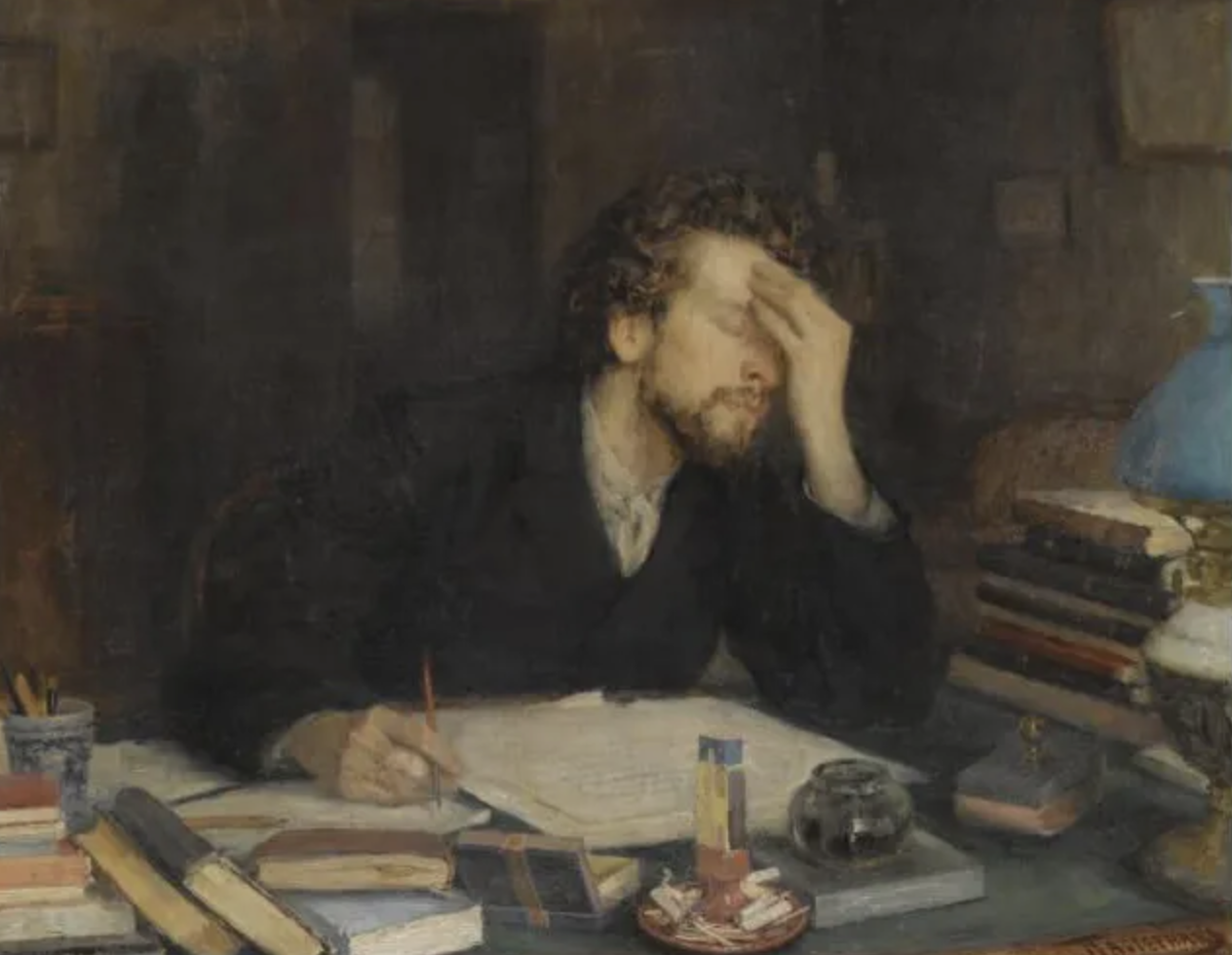
I’ve been marking undergraduate student essays for almost twenty years. As all of us who are engaged in this brutal labour know, marking is some of the hardest and most undervalued work we undertake as university teachers. It is time consuming, it is laborious, it is frustrating, joyful, sad. It is fraught with the interpersonal emotional dynamics of having your judgement become a numerical calculation that sits as the evaluation of someone else’s work.
Like most teachers, to break up the monotony, I’ve collected lots of examples of unintentional student hilarity over the years. Some of my favourites include [on the 1964 stage version of Othello, with Olivier in blackface]: ‘the most offensive thing about this production was that it subjected the audience to the entirety of Shakespeare’s script.’ And [on a play where a female character is the victim of sexual violence]: ‘We can therefore conclude that she wouldn’t have enjoyed being raped.’
I used to save and sometimes share these privately, always judging a little my colleagues who shared such quotes publicly on Twitter or Facebook. It was a violation of the student-teacher contract, I felt, to publicly mock a student’s poor work for likes. Now, though, I see it differently: These posts were not mocking the students. They were revelling in the process of learning. They were evidence that our students were grappling with new ideas. Struggling to express their understanding was a necessary and lovely rite of passage. Most of us can recall the first time we sat down at the blank page, filled with the terror of towering ideas we hadn’t quite grasped, and tried to meld these radical concepts into our own words and thoughts. Witnessing that wrangle on the page was a true joy of marking and —despite the huge, unacknowledged effort of it — I always really enjoyed engaging with student work. I liked marking, and think I was good at it (in that I was thorough and usually fair).
The great loss of AI for me is not that it somehow hampers our ability to ‘accurately’ ‘assess’ student attainment (scare quotes to indicate I am not even sure how accurate we could be before AI, or even what accurate would mean). It is not even that it has turned marking from a torturous pleasure into actual torture (you try spending a week reading fifty five-thousand-word essays on ‘cultural capital in the music industry’ generated by a bot). It is that it robs students of the vital and essential process of wrestling with the whisper of a profound thought and trying to compose words for it. This is how those of us who find ourselves through thinking, writing and making do it. We go through the pain. We try and fail and try again later. We write clichés, remove clichés. We wonder if clichés can sometimes offer a necessary graspable profundity. The process of writing is the process of thinking; the process of thinking is the process of becoming. Thinking and writing ill-conceived thoughts, failing to fully capture the essence of your thinking in words — this is how we develop critical skills. We sharpen our minds through sharpening our expression. The wholesale embrace of AI by undergraduates (and postgrads too, though I teach fewer of those) means the entire project of the humanities suddenly feels very pointless. Even students who have invested tens of thousands of pounds in the promise of the humanities no longer have faith in it.
I can’t say I blame them.[1] We have developed an education system in which individual students perceive their value as intrinsically tied to their grades. We have told them that educational attainment (not education itself) is the investment they are making in their future. Why would they not make use of a technology that makes it easier/possible to perform competence when the culture has no tolerance for incompetence?
Meanwhile, I sit contemplating this pile of essays, pining for a poorly expressed thought. Please, student, give me your terrible mistake.
[1] You would be forgiven for thinking I personally eschew AI. I’ve spent the last few months using it as a tool for various tasks, such as acting as a peer-reviewer on my own essay draft, workshopping ideas, or taking the aggression out of emails written in anger. I have never used AI to generate published writing. I also want to know what it can do, as I need to be able to advise my students. To do so, I need to recognise its strengths and flaws. I have mainly used ChatGPT and Claude. My conclusion is: AI is a reasonably useful tool. If you are one iota beyond competent, everything it generates will be worse than what you can already do. It can give useful insights and feedback on writing, though it is contradictory and frequently wrong. Socially and environmentally, I think I find it too ruinous to use beyond this research and discovery phase.


Leave a comment